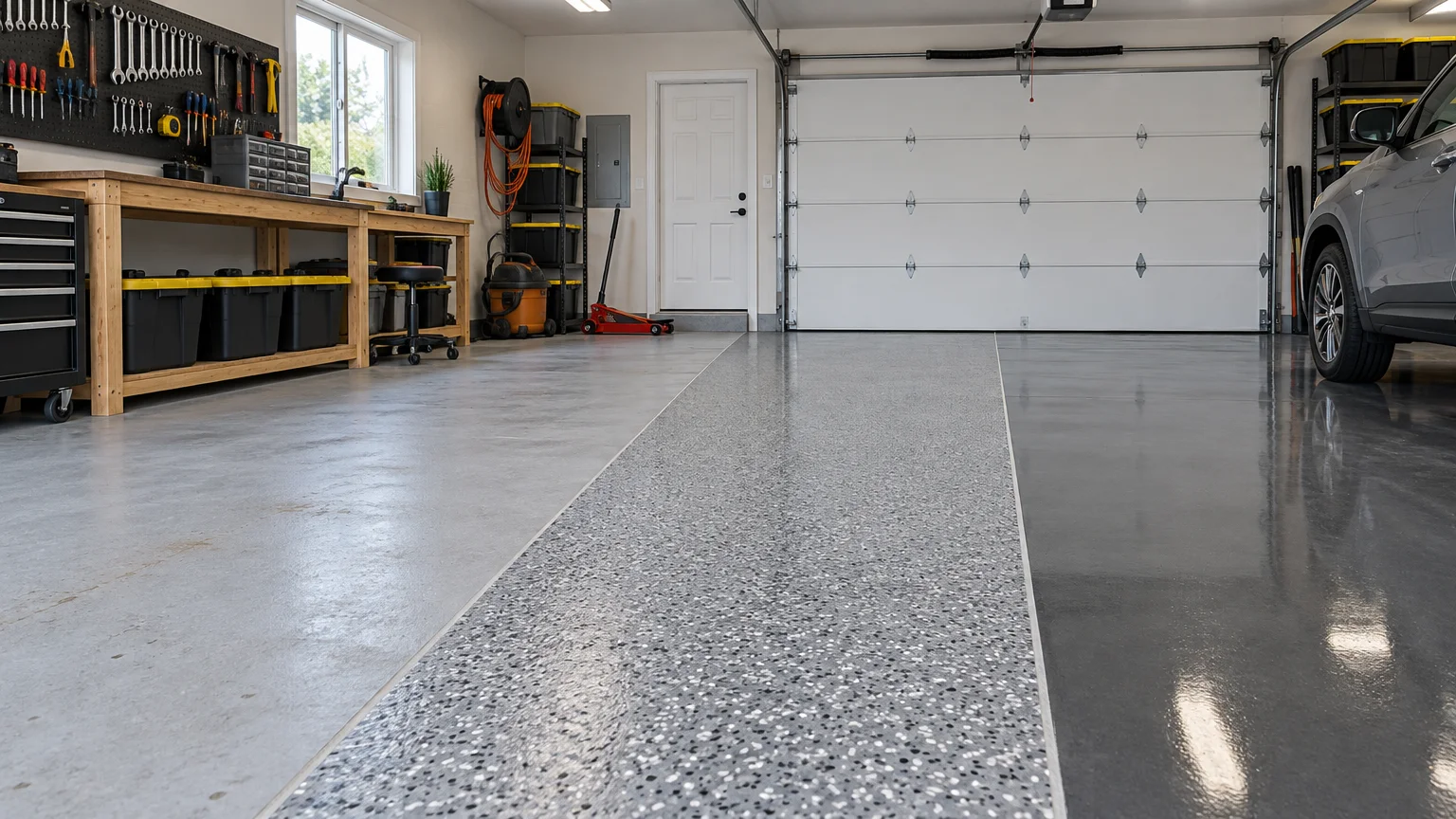
Garage Floor Paint vs Epoxy vs Polyaspartic
TLDR
In the garage floor paint vs epoxy vs polyaspartic decision, use one-part floor paint for a simpler, lower-commitment cosmetic refresh; choose a true two-part epoxy when you want a more substantial DIY coating and can devote serious time to preparation and curing; consider a complete polyaspartic system when rapid return to service is important and the installation can be planned around its shorter working time. None of these products can compensate for oil contamination, trapped moisture, weak concrete, or poor surface preparation.
The right answer starts with the slab, not the color chart. Determine what is already on the concrete, whether moisture is moving through it, how much sunlight reaches the floor, and how long the garage can remain empty. Then select a complete system whose written preparation, temperature, moisture, and cure requirements fit those conditions.
Garage floor paint vs epoxy vs polyaspartic at a glance
| Option | Best fit | DIY difficulty | Return to service | Main limitation |
|---|---|---|---|---|
| One-part garage floor paint | Storage areas, light-duty garages, and budget-conscious cosmetic refreshes | Lowest of the three, although preparation still matters | Varies by product; follow the label before walking, moving equipment, or parking | Usually a thinner, lower-commitment finish that may need earlier maintenance under demanding traffic |
| Two-part epoxy | Daily-use garages and workshops where the owner can prepare carefully and accept downtime | Moderate to high; mixing, batch timing, edges, and coverage must be coordinated | Product-specific; one documented water-based kit permits light foot traffic after 12–16 hours and vehicles after three days under stated conditions | Limited pot life and sensitivity to slab condition, preparation, temperature, and application timing |
| Polyaspartic system | Fast-turn projects, decorative flake floors, and jobs where a coordinated coating system is being professionally installed | High for first-time DIYers because working time may be short | Often selected for fast return to service, but the exact schedule is system- and condition-specific | Fast curing leaves less room to correct mixing, spreading, or broadcast mistakes |
Those categories are useful, but they are not performance grades. A carefully installed product over sound, properly prepared concrete can outperform a more expensive chemistry installed over contamination or a damp slab. Compare complete systems rather than assuming that every product carrying the same chemistry name behaves identically.
Decode the label before comparing products
The word “epoxy” on the front of a can does not always mean a true two-component coating. Benjamin Moore, for example, identifies GarageGuard as a one-part, epoxy-modified acrylic concrete and garage-floor paint. It is ready to use rather than a resin-and-hardener system mixed immediately before application.
A true two-part epoxy has separate components that react after mixing. Rust-Oleum’s documented EpoxyShield garage-floor product is a two-part, water-based epoxy with temperature-dependent induction and usable-pot-life instructions. Once the components are combined, the clock is running. You need a mixing plan, cut-in strategy, roller setup, and clear path out of the garage before starting.
Polyaspartic coatings are also reactive systems rather than ordinary paint. Manufacturers offer them as primers, build coats, clear coats, or parts of decorative broadcast systems. Sherwin-Williams describes relevant polyaspartic products in terms of fast curing, abrasion and chemical resistance, and color or UV stability, but those are product-family claims—not proof that every polyaspartic coating will outperform every epoxy in every garage. Read the technical data sheet for each layer in the proposed system.
The slab decides whether the coating stays attached
Surface preparation is not a ceremonial cleaning step. It is how you create a sound, contaminant-free surface with the profile required by the coating manufacturer. The International Concrete Repair Institute’s coating-installation methodology treats substrate evaluation, preparation, environmental conditions, and material selection as connected parts of a successful installation.
Look for contamination and incompatible material
Oil spots, tire residue, silicone, wax, old coatings, sealers, and curing compounds can interfere with adhesion. Water beading on the slab can suggest a sealer or contamination, but it does not identify the material or prove that the rest of the floor is clean. Existing coatings must be checked for adhesion and compatibility. Peeling material should not be buried under another coat.
Degreasing may require repeated treatment, agitation, rinsing, and complete drying. Deeply oil-soaked concrete can remain a poor coating candidate even after the surface looks better. If contamination cannot be removed to the chosen manufacturer’s standard, consider leaving the floor uncoated, replacing affected concrete, or using another floor treatment designed for the condition.
Test moisture using the system’s written requirements
Moisture vapor moving through concrete can contribute to blistering, loss of adhesion, or other failures. A taped plastic sheet may reveal obvious condensation, but it is only a screening clue. It does not replace the test method or acceptance threshold required by the coating manufacturer. ICRI publishes dedicated guidance on moisture evaluation and mitigation in concrete floor slabs.
Ask what test is required, who performs it, where tests must be located, and what result the selected primer or coating can accept. If the slab exceeds that limit, the next step may be a compatible mitigation system—not simply a heavier finish coat.
Grinding versus etching is a specification question
Diamond grinding can remove weak surface paste, many existing coatings, and some contamination while producing a controlled profile. It also creates substantial dust and requires suitable collection equipment. Acid or chemical etching may be allowed by some consumer systems on suitable bare concrete, but it will not reliably remove every sealer, coating, oil deposit, or weak surface layer.
Do not choose between grinding and etching by habit. Follow the current technical data sheet and evaluate what must be removed. A floor with old paint and tire-polish contamination presents a different preparation job from clean, unsealed concrete.
Cracks and joints need separate decisions
A coating changes the surface appearance; it does not stop structural movement. Static cracks may accept a compatible repair after preparation, but active cracks can reflect through rigid coatings. Control joints and expansion or isolation joints have different purposes and should not automatically be filled with the same material used for small defects. Ask the system manufacturer how each joint type should be handled.
Which coating fits your garage?
Storage or light-duty use
One-part garage-floor paint can be enough when the goal is a cleaner-looking storage area and the owner accepts periodic touch-ups or recoating. Confirm that the exact product is approved for garage floors and automotive traffic. A porch-and-patio label is not sufficient: one supplied Behr technical sheet explicitly excludes garage floors and areas exposed to automotive traffic.
Daily-driver garage or home workshop
A two-part epoxy is often the realistic serious-DIY route. It gives the installer more decisions to manage—surface profile, mixing, induction time where specified, pot life, batch edges, film coverage, and cure protection—but consumer-oriented kits can provide a defined workflow. For one Rust-Oleum system, the documented schedule is 12–16 hours before light foot traffic and three days before vehicle traffic under its stated conditions. That schedule cannot be transferred to another product or to colder, hotter, or otherwise different conditions.
Vehicle traffic clearance also does not automatically answer when concentrated loads are acceptable. Jack stands, rolling cabinets, motorcycle stands, lifts, and heavy workbenches can impose smaller contact points or sustained loads. Obtain written guidance for those uses rather than treating “vehicle ready” as permission for every shop task.
Sunny garage or fast-turn renovation
A polyaspartic system deserves consideration when the door stays open frequently, the floor receives substantial sunlight, or a contractor must return the garage to service quickly. Relevant manufacturers publish polyaspartic options with fast-curing and UV or color-stability characteristics, but performance depends on the selected primer, body coat, broadcast material, and topcoat.
Speed creates a tradeoff. A short recoat window can help complete a multi-layer floor quickly, but limited working time leaves less room for a first-time installer to recover from a late batch, dry edge, uneven flake broadcast, or roller problem. For that reason, a full polyaspartic flake floor is commonly a better contractor comparison project than a casual one-person DIY job.
Damp, oily, peeling, cracked, or spalling concrete
Pause the coating purchase. Identify the moisture source, remove unsound material, test old coatings, investigate contamination, and determine whether cracks are stable. Spalling or weak concrete needs repair compatible with the eventual system. No finish coat should be expected to glue a failing surface back together permanently.
Traction, flakes, and everyday maintenance
A glossy floor can become slippery when wet or contaminated. Decorative flakes can add visual texture and hide dust, small chips, and repair marks, but the finished traction depends on the broadcast density, topcoat, and any specified aggregate. One epoxy manufacturer advises using a compatible anti-skid additive, or a clear coat containing one, when additional slip resistance is wanted.
More texture is not automatically better. Aggressive aggregate can make sweeping and mopping harder, catch shop towels, feel rough when kneeling, and increase resistance under creepers or small tool-cart casters. Choose texture for the actual hazard: wet tires near the door may justify more grip than a dry bench area. Use only additives approved for the coating and apply them at the specified rate.
Safety is part of the coating system
Read both the technical data sheet and safety data sheet before buying. Plan chemical-resistant gloves, eye protection, ventilation, spill control, and disposal around the specific components. Keep ignition sources out of the work area when the product documentation identifies a flammability risk.
Some reactive coating components can present hazards that ordinary water-based wall paint does not. OSHA’s isocyanate safety overview identifies respiratory, skin, and eye hazards associated with isocyanates. The SDS should drive respirator and ventilation decisions; a dust mask is not a substitute for chemical-vapor protection. Spraying a reactive coating in a residential garage should not be treated as a shortcut without the training, containment, and protective equipment the product requires.
Pre-purchase checklist
- Identify every existing coating, sealer, curing compound, repair, and contaminated area you can find.
- Check whether cracks are static or moving, and distinguish control joints from expansion or isolation joints.
- Obtain the current technical data sheet and safety data sheet for the primer, color coat, flakes or aggregate, and topcoat.
- Confirm the required concrete profile and whether the manufacturer permits grinding, shot blasting, etching, or another preparation method.
- Use the moisture test and acceptance limit specified for the complete system.
- Check slab temperature, air temperature, humidity, dew-point restrictions, and forecast conditions for every application and cure stage.
- Calculate coverage from the manufacturer’s specified application rate, then plan manageable batch sizes and mixing locations.
- Map pot life, induction time, recoat windows, edge work, roller changes, and flake broadcasting before mixing.
- Choose traction deliberately based on water exposure, cleaning effort, kneeling comfort, and wheeled equipment.
- Schedule walking, equipment replacement, vehicle parking, jack stands, and other concentrated loads only according to written product guidance.
What to ask a polyaspartic-floor contractor
- What exact products and layers are included, and can I see the current technical and safety data sheets?
- How will you identify and remove sealers, old coatings, oil, and weak concrete?
- What concrete profile will you create, and how will dust be controlled?
- Which moisture test will you use, and what result is acceptable for the proposed system?
- How will cracks, control joints, and expansion joints be treated?
- What texture or anti-slip material is included in the final coat?
- What are the written return-to-service times for foot traffic, vehicles, and concentrated shop loads under expected conditions?
- What preparation defects, moisture conditions, hot-tire effects, or slab movement are excluded from the warranty?
The practical choice
Choose paint when you want a straightforward cosmetic improvement and can accept a lower-commitment finish. Choose two-part epoxy when you have a sound slab, enough preparation equipment, and time for measured DIY work and curing. Consider polyaspartic when rapid turnaround or a coordinated decorative system justifies the cost and tighter application logistics.
Before selecting any of them, clear a few test areas and diagnose the concrete. Find out what is on the slab, assess contamination and moisture, inspect cracks and joints, and read the proposed system’s current documentation. The coating whose preparation demands and cure schedule fit your garage is a better choice than the one with the most impressive chemistry name.
References
- GarageGuard®
- GarageGuard® 1-Part Concrete & Garage Floor Paint – Satin | Benjamin Moore
- TECHNICAL DATA ESH-41
- TECHNICAL DATA ESH-48
- Polyaspartic Flooring | Sherwin-Williams | Sherwin-Williams
- Methodology for the Decision-Making Process for Successful Floor Covering and Coating Installation
- 310.2R-2013 (English PDF) – Selecting and Specifying Concrete Surface Preparation for Sealers, Coatings, Polymer Overlays, and Concrete Repair
- Guideline No. 710.3–2022
- T E C H N I C A L D A T A S H E E T
- Isocyanates – Overview | Occupational Safety and Health Administration