Garage Floor Crack Repair Before Coating: What Needs Attention First
The basic rule for garage floor cracks before epoxy is simple: repair stable cracks, pits, and unsound spots, but do not automatically fill every line with a rigid compound. A random crack that has stopped moving may be a straightforward repair. A control joint, perimeter isolation gap, or active crack must retain its ability to accommodate movement, usually through a joint detail specified by the coating manufacturer.
Do the diagnostic work before buying filler. Epoxy can make a floor easier to clean and improve its appearance, but it does not stabilize a moving slab, stop groundwater, or restore weak concrete. A hurried repair may look good initially and then reappear as a line through the coating.
Inspect the floor before choosing a repair
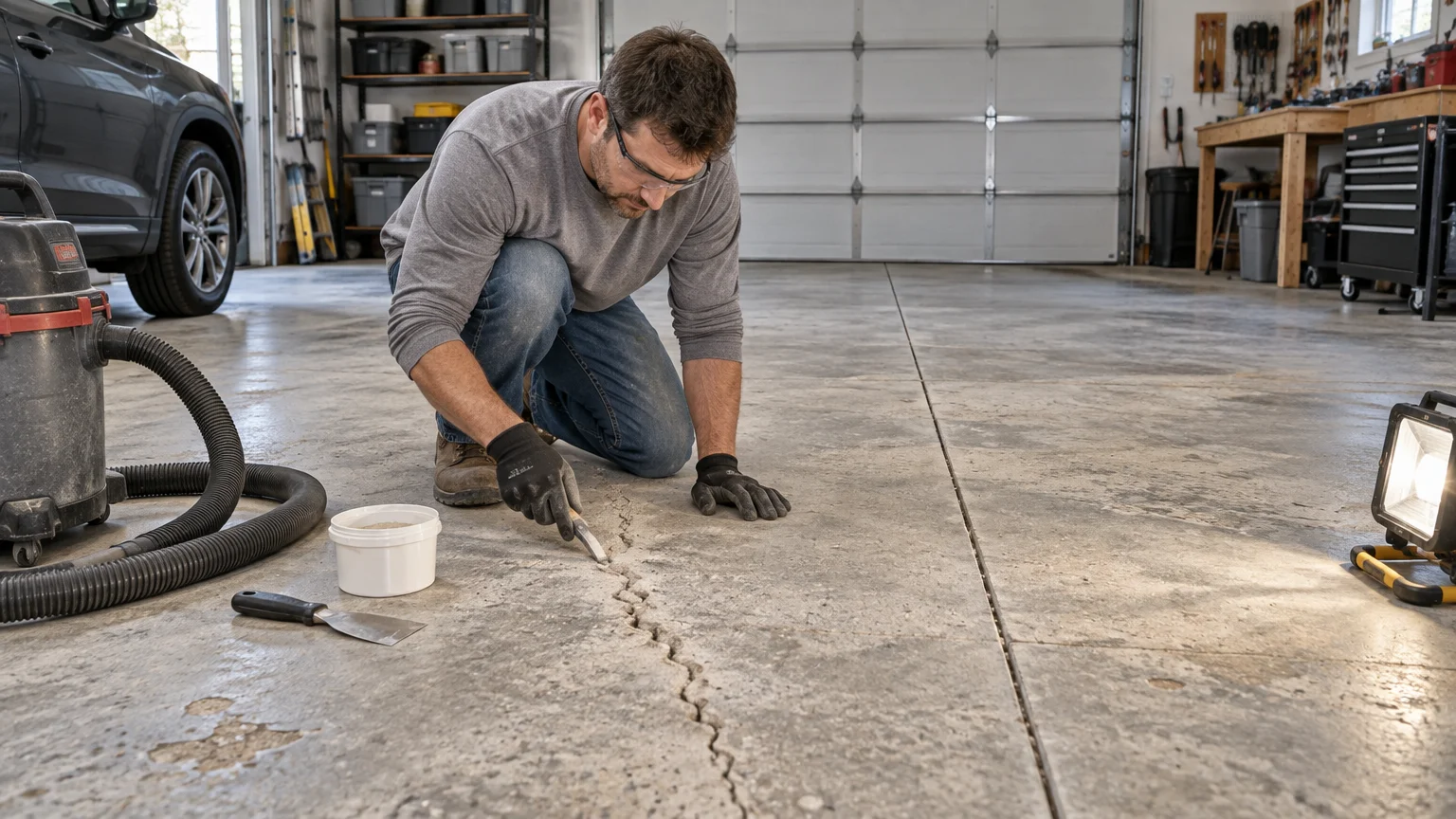
Clear the slab and inspect it under bright, low-angle light. Vacuum loose debris so the crack edges are visible. If possible, look at the floor after heavy rain as well as during dry weather. You are trying to understand the defect, not merely measure its width.
- Location: Note whether the line crosses the middle of a slab panel, follows a straight saw cut, circles a column, or runs along a wall or foundation.
- Height difference: Lay a straightedge across the line. One side sitting higher than the other is more concerning than a flat, tight crack.
- Edge condition: Probe gently with a screwdriver. Flaking, hollow, powdery, or crumbling concrete must be removed back to sound material before patching.
- Moisture: Look for damp areas, seepage, white mineral deposits, or staining that returns after cleaning.
- History: Note whether the crack is new, has grown, was repaired previously, or changes through the seasons.
- Contamination: Identify oil, grease, tire-care residue, paint, curing compounds, or a previous sealer that could interfere with adhesion.
Crack assessment is context-dependent. Cause, movement, orientation, water transmission, durability, and the condition of the surrounding concrete all matter; potentially active cracks may need an elastomeric treatment rather than a rigid repair. ACI guidance on assessing and repairing existing concrete provides the broader technical framework behind that distinction.
Is it a crack, saw cut, joint, or damaged patch?
A narrow line is not automatically a crack. Builders intentionally place joints and saw cuts so shrinkage or movement occurs at a planned location. Perimeter gaps and isolation joints separate the slab from walls, columns, or other structural elements. These features do a different job from a random crack and should not be treated casually.
| What you see | Likely condition | Pre-coating route |
|---|---|---|
| Irregular line through otherwise sound, level concrete | Possibly a static random crack | Confirm that it appears stable, then repair with a material compatible with the complete coating system. |
| Straight, deliberate cut forming slab panels | Saw-cut control or contraction joint | Follow the coating-system joint detail; do not assume it should be rigidly buried. |
| Gap beside a wall, column, drain, foundation, or separate slab | Isolation, perimeter, or expansion detail | Preserve its movement-accommodating function and use the specified flexible joint treatment where required. |
| Broken edges, pop-outs, shallow pits, or a failed old patch | Spall or unsound concrete | Remove weak material, clean the cavity, and rebuild it with a compatible patching product. |
| Crack with seepage, recurring widening, or a height difference | Possible moisture or movement problem | Pause the coating project and have the cause evaluated before making a cosmetic repair. |
No universal crack-width number can determine whether a repair is suitable for DIY work. A very narrow crack can still be active, while a wider old crack may be stable. Location, change over time, moisture, and vertical displacement provide more useful information than width alone.
Repairing a likely stable crack before epoxy
Once a crack appears stable and the surrounding slab is sound, choose the repair material as part of the coating system—not as an isolated hardware-store purchase. Check the coating manufacturer's instructions or technical support for compatible crack fillers and patches. The product data should also determine acceptable crack dimensions, application temperature, cure time, grinding time, and the interval before coating.
- Remove loose concrete, failed filler, dirt, and contamination from the crack. Do not leave weak edges simply because the opening looks small.
- Open, chase, or V-groove the crack only if the selected repair system directs you to do so. Some repair details call for a prepared groove; others are intended for narrower cracks and use a different installation method.
- Vacuum the crack thoroughly. Dust left on the sides and bottom can become a bond-breaking layer.
- Prime the repair area if the filler manufacturer requires it, then mix and place the material exactly as directed. Work it into the prepared cavity rather than smearing only the surface.
- Let the repair cure for the product-specific period. Cool conditions can alter working and cure times, so the label and technical data take priority over generic advice.
- Grind or sand the repair flush when permitted. Feathered ridges and proud filler can remain visible under the finished coating.
- Vacuum again and complete the coating manufacturer's required preparation for the entire slab.
Manufacturer garage-floor guidance similarly calls for cracks and holes to be repaired before epoxy, followed by sufficient curing, smoothing, and dust removal. The repair should be flush enough that the coating can form a consistent film, but smooth does not mean glossy or unprofiled.
What it means to honor a joint
To “honor” a joint means carrying its movement-accommodating function through the flooring system instead of locking it beneath a continuous rigid layer. Depending on the specified system, that can involve terminating the coating at the joint, recutting the joint after coating, or installing a compatible flexible sealant detail. The correct route depends on the joint type, expected movement, and exact coating products.
Do not fill an isolation or expansion joint with a rigid crack filler merely to create a seamless floor. Potentially active cracks also need special consideration. Sherwin-Williams' concrete-preparation guidance distinguishes static cracks from movement-capable cracks and joints, directing rigid repair toward static defects while accommodating movement with an appropriate flexible treatment.
Control joints require system-specific judgment. Although they are deliberate weakened planes rather than expansion joints, cracking and minor movement can occur there. Some decorative systems use details that preserve a visible joint; others have manufacturer-approved methods for treating it. If the instructions are unclear, ask the coating manufacturer to specify the detail in writing before installation.
Prepare the whole slab, not just the repair
A neat crack repair cannot compensate for a poorly prepared floor. Concrete may look clean while still carrying oil in its pores, a clear sealer, weak laitance, tire residue, or dust. Surface-preparation guidance emphasizes that the substrate must be sound and that oil, grease, curing compounds, dirt, laitance, and other bond-breaking material must be removed.
Many garage epoxy systems require mechanical preparation rather than cleaning alone. For example, Sika's garage guidance describes mechanical preparation producing a profile comparable to ICRI CSP 3 for that system. That does not establish one universal profile for every coating; it demonstrates why the instructions for the exact primer and coating matter.
Grinding, shot blasting, or another approved method should expose sound concrete and create the specified surface profile. It also reveals weak patches that washing can hide. Edges, corners, and the area beneath the garage-door seal need the same attention as the open center of the bay.
Moisture deserves a separate check. Moisture vapor and insufficient preparation can contribute to blistering or loss of adhesion in concrete floor finishes. Use the test method and acceptance limits required by the selected coating manufacturer. A dry-looking surface on one afternoon is not proof that the slab meets those limits.
If you are still selecting a finish, compare the preparation demands and installation constraints in our guide to garage floor paint, epoxy, and polyaspartic coatings before committing to a system.
Will the repaired crack disappear?
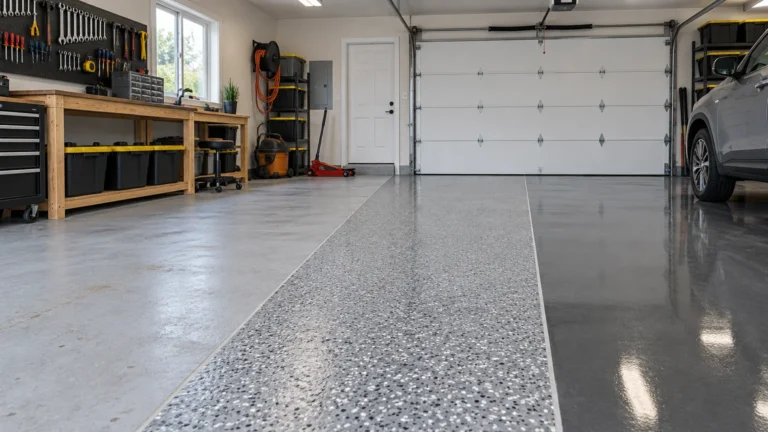
A well-executed repair can make a stable crack much less noticeable, especially beneath a broadcast-flake finish. It cannot guarantee invisibility. Slight differences in repair texture, absorption, or elevation can show through a thin coating, and an old line may remain visible under strong side lighting.
More importantly, rigid epoxy does not prevent concrete movement. If the slab moves after coating, a crack can telegraph through the repair and finish. Epoxy-system guidance warns that concrete movement and cracking can transfer through a rigid flooring system. A flexible joint treatment can accommodate some expected movement, but it does not correct settlement, heave, drainage trouble, or another underlying cause.
Delay coating when the slab is still telling you something
Stop and investigate before applying epoxy if you find any of the following conditions:
- Active seepage, persistent dampness, or moisture-test results outside the coating manufacturer's limits
- Recurring white deposits or staining that suggests unresolved moisture movement
- A crack with measurable vertical displacement
- A crack that is widening, recurring through previous repairs, or appearing in several connected areas
- Powdery, scaling, hollow, delaminated, or easily broken concrete
- Oil or another contaminant that remains after the prescribed cleaning process
- A peeling old coating or an unidentified sealer that has not been removed
- A joint type you cannot confidently identify or detail
- Drainage, frost, soil movement, or foundation symptoms that may be contributing to slab movement
These signs do not establish a structural diagnosis by themselves. They mean that a cosmetic coating project should wait until the relevant moisture, concrete, drainage, or movement issue has been evaluated. Epoxy makes later investigation and repair more disruptive, so this is the right time to be cautious.
Control concrete dust during grinding
Concrete grinding can generate respirable crystalline silica dust. OSHA identifies grinding as a dust-generating activity and describes controls such as water delivery or local exhaust ventilation with dust collection. OSHA's silica-control requirements should inform the work method rather than relying on an ordinary shop vacuum or a disposable dust mask alone.
Use equipment and controls appropriate to the task, follow the tool and vacuum manufacturers' instructions, and wear the specified eye, hearing, skin, and respiratory protection. Keep other people out of the work area. Do not dry sweep the dust or blow it around with compressed air; collect it with the approved dust-control and cleanup method.
The practical bottom line
Repair sound, stable cracks and damaged spots before coating, then flatten and clean those repairs as the selected products require. Preserve control, isolation, expansion, and perimeter joints according to the exact flooring-system detail. Do not use rigid filler as a shortcut around movement or moisture.
Your next step is to map every line and damaged area on the cleared floor, mark likely cracks and joints separately, and inspect for moisture, contamination, weak concrete, and height differences. Only after that inspection should you choose the repair products and coating system. The durable result comes from matching each defect to the right treatment—not from making every line disappear.
References
- Concrete Surface Preparation for Water and Wastewater
- Surface Prep Guide
- industrial.sherwin-williams.com
- Code Requirements for Assessment, Repair, and Rehabilitation of Existing Concrete Structures (ACI 562) and Commentary (Provisional Standard)
- 3 PREPARE
**A – Cracks repair**
Any cracks or h - Epoxy Flooring: The Complete Guide | Sherwin-Williams
- What does the rule require? | Occupational Safety and Health Administration
- www.osha.gov