Dust Control in a Garage Workshop Without a Full Dust-Collection System
You can control a surprising amount of garage workshop dust without installing a large collector or permanent ductwork. The practical setup is a capable vacuum or portable dust extractor connected directly to the tool, short hoses with tight adapters, an air cleaner for escaped particles, and a cleanup routine that does not throw settled dust back into the air.
The order matters. Capture dust where it is made first. Use room filtration second. Clean surfaces and floors last. Simply opening the garage door, mounting a filter near the ceiling, or wearing a mask while the entire shop fills with dust tackles the problem too late.
Start with dust capture at the tool
Local exhaust at the saw, sander, router, or other machine is the primary woodworking dust control. General ventilation and room air cleaners can reduce material that escapes, but they do not replace capture at the source. Both the OSHA woodworking dust guidance and the UK Health and Safety Executive put the emphasis on effective extraction at the machine.
For a small garage shop, that usually means connecting a portable extractor or suitable shop vacuum to one tool at a time. This arrangement is especially useful with random-orbit sanders, track saws, circular saws, portable routers, and other tools designed around relatively small dust ports. Sanding, routing, and shaping are among the operations that deserve the most attention because they can generate substantial airborne dust.
A dust port is only the starting point. Collection falls apart when an adapter leaks, a hose is split, the filter is loaded, or the hose run adds unnecessary resistance. Keep the hose as short and direct as the work allows. Use properly fitting adapters rather than layers of loose tape, and support the hose so its weight does not pull it off the tool halfway through a cut.
Before each dusty session, check the connection at the tool, inspect the hose for holes or crushing, empty an overfilled container, and confirm that suction is present. OSHA advises inspecting and cleaning ducts and collectors and checking for loose, broken, or damaged ducting. HSE likewise recommends monitoring airflow and maintaining extraction equipment according to its manufacturer’s requirements.
Build a compact three-layer system
| Layer | Practical equipment | What it does | What it cannot do |
|---|---|---|---|
| Source capture | Tool shroud or dust port, short hose, portable extractor or suitable shop vacuum | Collects chips and fine dust before they spread through the garage | Cannot catch dust that misses the hood or escapes an open cut |
| Room filtration | Portable or ceiling-mounted air cleaner sized for the room | Recirculates room air through filters and reduces suspended dust that escaped capture | Does not replace a tool connection or capture heavy chips |
| Final cleanup | Appropriate filtered vacuum, damp wiping, and wet mopping where suitable | Removes settled material without deliberately launching it back into the air | Does not correct poor capture during machining |
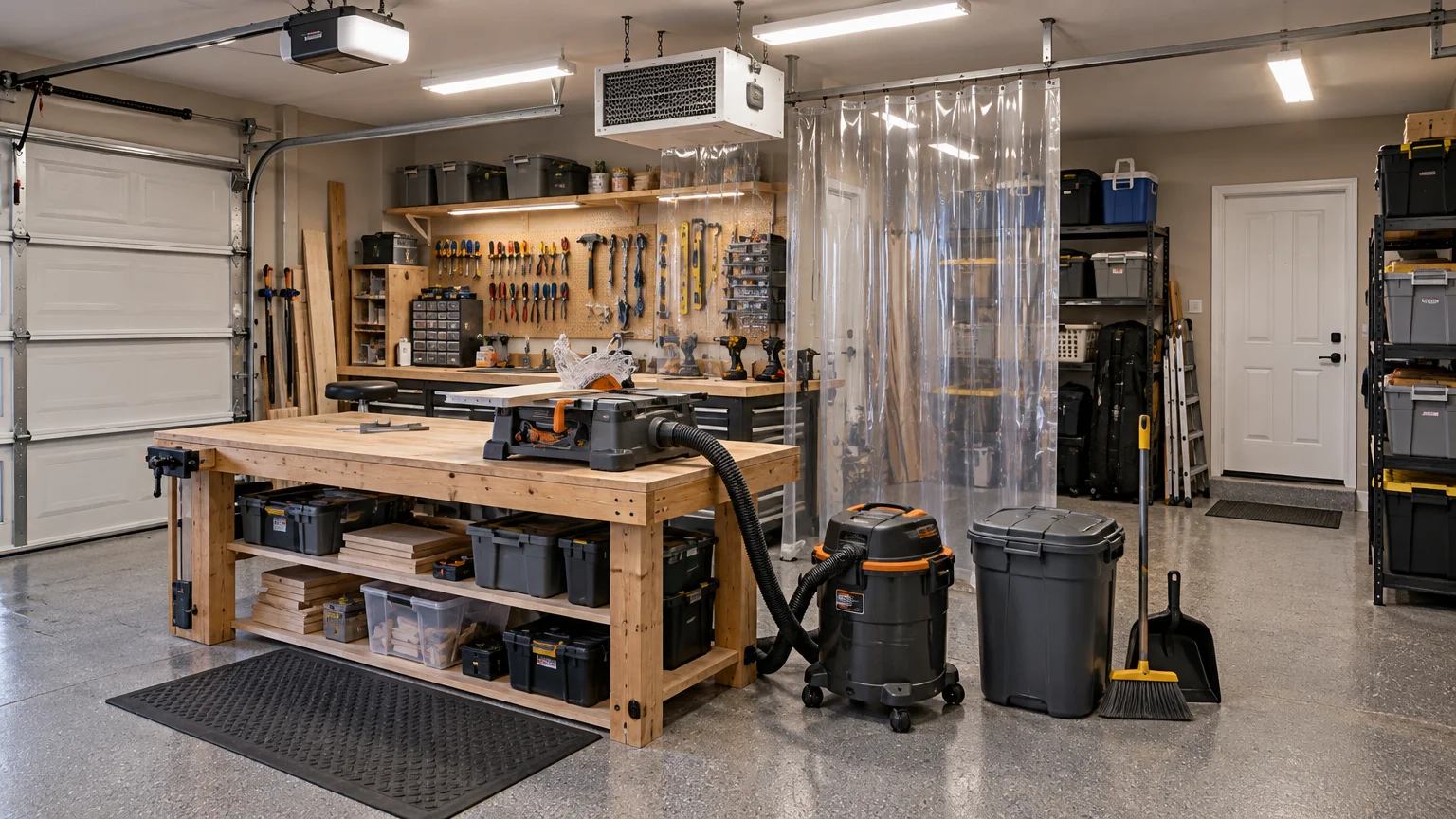
This layered arrangement is more useful than spending the entire budget on one oversized device. Put the best capture you can manage at the dust-producing tool, then use filtration and cleaning to deal with what gets away.
Choose the vacuum or extractor around the work
Check the tool manufacturer’s instructions and the extractor’s current manual before buying adapters or filters. Port size, airflow needs, static pressure, filter compatibility, electrical load, and approved dust classes vary by equipment. A small-port sander and a planer throwing a heavy stream of chips are not equivalent collection jobs.
If you use a separator or pre-collection bin, treat it as a convenience rather than proof that the air leaving the vacuum is clean. It may keep bulk debris out of the main container, but the vacuum’s final filtration, seals, condition, and intended application still matter. Do not assume that fitting a filter marked HEPA to an ordinary vacuum turns the complete machine into a sealed HEPA vacuum. EPA’s definition for lead-safe work includes HEPA as the final filtration stage, 99.97% capture at 0.3 microns, and construction that prevents bypass leakage.
Size an air cleaner by room volume
An air cleaner is useful after source capture, particularly in a garage where fine dust can remain suspended and later settle on shelves, door tracks, vehicles, and stored belongings. Compare units using delivered filtered airflow at the speed you will actually run, not only a broad room-size claim.
A useful planning calculation is air changes per hour: multiply filtered airflow in cubic feet per minute by 60, then divide by the room volume in cubic feet. A 20-by-20-foot garage with a 9-foot ceiling has a volume of 3,600 cubic feet. If a cleaner delivers 600 filtered CFM under the relevant conditions, the calculation is 600 × 60 ÷ 3,600, or 10 theoretical air changes per hour. Real performance will also depend on filter loading, placement, obstructions, and how well air circulates through the room. Manufacturer coverage claims are tied to stated operating conditions.
Mount or position the cleaner where it can establish a broad circulation path without blowing directly across the dusty operation and into your face. Keep the intake and outlet clear of lumber racks, cabinets, and the raised garage door. Run it during the job and afterward according to the product instructions, then inspect and service its filters on the schedule specified for that exact model.
Contain dust before it reaches the house
An attached garage needs a clean-side boundary. Keep the door into the house closed, seal obvious gaps where practical, and avoid carrying dusty clothing, extension cords, and tools through living areas before cleaning them. Cover stored items that are difficult to clean, move vehicles out of the work zone, and isolate nearby open shelving with temporary sheeting when a project will produce a large amount of dust.
Opening the overhead door may improve general airflow, but it is not a complete control method. Cross-drafts can pull contamination through the breathing zone, disrupt extraction, or spread dust across the garage. Effective exhaust should move contaminants away from people rather than merely create noticeable air movement.
Pay attention to combustion appliances and other equipment in the garage. Do not improvise powerful exhaust arrangements that could affect appliance venting or pressure relationships in the building. If the plan involves permanent exhaust fans, altered ducts, or uncertain combustion-air conditions, have the design checked by an appropriate building or HVAC professional.
Clean without making a second dust cloud
Do not finish a careful extraction setup by attacking the floor with compressed air, a leaf blower, or aggressive dry sweeping. Those methods put fine material back into suspension and distribute it onto shelves, door hardware, vehicles, and your lungs. OSHA recommends wet methods or HEPA-filtered vacuuming where feasible for silica-related cleanup, while EPA lead-safe guidance uses HEPA vacuuming followed by wet wiping or mopping.
For ordinary wood dust, vacuum the tool, bench, nearby horizontal surfaces, and floor with equipment appropriate for the material. Work from high surfaces toward the floor. Use damp wiping where the surface can tolerate it, and avoid soaking unfinished tools, cast-iron tables, electrical equipment, or wood that could swell. Empty and service the vacuum without creating another plume; follow its manual for bag changes, filter cleaning, disposal, and protective equipment.
Know when ordinary wood-dust controls are not enough
A woodworking setup is not a universal hazardous-dust system. Cutting concrete or masonry can create respirable crystalline silica. Disturbing old paint may release lead dust. Suspect asbestos-containing materials, metal grinding, welding fumes, and solvent vapors all require hazard-specific decisions about containment, ventilation, filtration, respiratory protection, cleanup, and disposal.
Renovation work in a home built before 1978 deserves particular caution because disturbing painted surfaces can create dangerous lead dust. EPA’s lead-safe renovation guidance for DIYers calls for containment, HEPA-equipped tool attachments, frequent cleanup, and keeping children, pets, and pregnant people away from the work area. If the material is unknown, identify the hazard before cutting, drilling, sanding, or grinding it.
A respirator can provide an additional layer of protection, but it is not a substitute for source capture and ventilation. Selection must match the hazard, and fit, seal, use, and maintenance all affect protection. Workplace respiratory-protection programs also carry requirements that go beyond buying a disposable mask. The NIOSH guide to respirators used for construction dust is a useful starting point, but hazard-specific instructions still control.
A workable routine for the next dusty project
- Identify the material and process. Stop if lead, silica, asbestos, fumes, or another specialized hazard may be involved.
- Move vehicles and unnecessary stored items out of the dust zone. Close the door to the house and protect surfaces that are hard to clean.
- Connect the tool to a compatible extractor or vacuum with the shortest practical hose and a tight adapter.
- Inspect the hose, seals, container, and filter. Confirm airflow before starting the cut or sanding pass.
- Position room filtration so it circulates air without pulling dust through your breathing zone.
- Use the tool’s guards and dust shrouds as designed. Do not remove safety equipment merely to improve hose access.
- Vacuum the tool and work surface before disconnecting the hose. Then clean surrounding surfaces from high to low.
- Inspect filters and collection containers after the job and service them according to the exact equipment manual.
Good garage workshop dust control is less about owning a giant collector than applying the controls in the right sequence. Capture at the tool, keep the work separated from the house, filter the air that escapes, and remove settled dust without launching it again. Start by improving the connection on your dustiest handheld tool; that small, repeatable fix usually does more useful work than relying on an open garage door and hoping the dust finds its own way outside.
References
- eTool : Woodworking – Production – Wood Dust | Occupational Safety and Health Administration
- Wood dust – HSE
- eTool : Woodworking – Assembly – Fire and Explosion | Occupational Safety and Health Administration
- Frequent Questions About Work Practice Standards Under the RRP Rule | US EPA
- Air Filtration System 5-Micron Filter 1196 CFM | Powermatic
- Silica, Crystalline – Occupational Exposure to Respirable Crystalline Silica 29 C.F.R. § 1926.1153 | Occupational Safety and Health Administration
- How can homeowners protect themselves and their families from exposure to lead dust if they plan on doing their own renovations? | US EPA
- Lead-Safe Renovations for DIYers | US EPA
- A Guide to Respirators Used for Dust in Construction | NIOSH Science Bulletin | CDC
- Wood Dust – Possible Solutions | Occupational Safety and Health Administration