
How Deep Should a Garage Workbench Be?
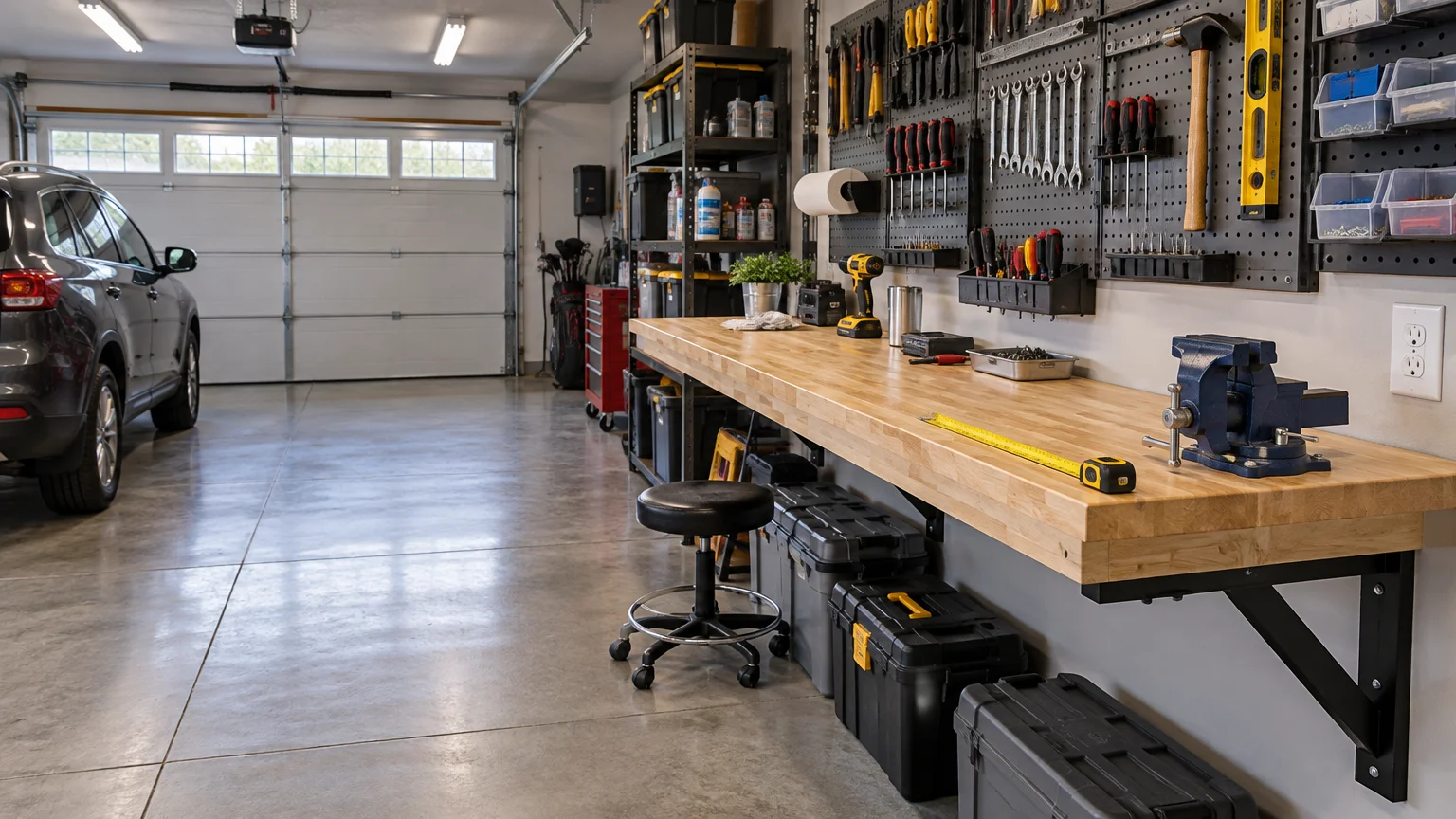
For most homeowners, a garage workbench should be about 24 inches deep. That is enough room for repairs, small power tools, benchtop projects and parts trays without turning the back of the bench into unreachable storage. It also matches the 24- to 25-inch depth used by several current commercial garage workbenches from Seville Classics, Husky and Gladiator.
Treat 24 inches as a practical starting point, not a mandatory standard. A 20-inch bench can work well in a tight one-car garage. A 25- to 30-inch top provides more support for assemblies, but its rear edge becomes less convenient when the bench sits against a wall. Before cutting lumber or buying a bench, consider what you build, how far you can comfortably reach and how much clear floor remains when a vehicle is parked.
Workbench depth recommendations at a glance
| Bench depth | Best use | Main compromise |
|---|---|---|
| 18–20 inches | Tight garages, light repairs, tool charging and narrow utility benches | Limited support for larger parts and benchtop machines |
| 24–25 inches | General repairs, DIY projects, woodworking and everyday garage use | Rear portion is better for secondary items than frequently handled parts |
| 26–30 inches | Large assemblies, deeper machinery or a bench accessible from both sides | Harder to reach across when installed against a wall |
| Over 30 inches | Assembly tables and freestanding project islands | Consumes substantial floor space and usually requires access from multiple sides |
A commercial 20-inch-deep modular bench shows that a narrow top is a realistic option rather than merely a space-saving improvisation. At the other end of the practical range, Woodsmith’s compact Just-Right Workbench is 25½ inches deep before accounting for vise hardware. These examples bracket the useful range for many residential workshops.
Why 24 inches works in most garages
A 24-inch top balances usable surface area with human reach. Ergonomics guidance separates the close area used for frequent work from the farther maximum-reach area. California guidance places frequent standing tasks involving both hands within about 14 inches of the worker and one-hand tasks within about 18 inches. Texas guidance notes that many adults have a maximum work area of roughly 22 to 26 inches without leaning. California’s Easy Ergonomics guidance
That does not establish an official workbench-depth standard. It does explain why a 24-inch wall bench feels useful at the front and less convenient at the back. Keep the vise, current project, measuring tools and frequently used parts near the front. Reserve the rear strip for a task light, battery chargers, small organizers or tools you pick up less often.
A deeper top does not automatically create a better workstation. If you must bend over every time you retrieve a fastener, the extra six inches are functioning as clutter parking rather than productive space. Depth should support the work without encouraging a permanent row of tools along the wall.
Choose the depth around the work you actually do
Use 18 to 20 inches when the vehicle bay is tight
A shallow bench makes sense when a car door, lawn mower, bicycle route or garage door track already limits the workspace. Twenty inches can accommodate a grinder, small vise, charging station or trays used for mechanical repairs. It also leaves less surface available for clutter.
The tradeoff appears when working on a cabinet, mower component or long assembly. There is less room behind the part for clamps, cords and tools. A shallow bench is most effective when paired with wall storage, drawers or a rolling cart that can provide temporary support.
Use 24 to 25 inches for a general-purpose bench
This is the safest default for a garage workshop that handles a mixture of household repairs, vehicle parts and woodworking. It provides enough depth for many benchtop tools while preserving reasonable reach from the front. Current examples include 24-inch Seville Classics and Husky models and a 25-inch Gladiator bench.
Do not copy the load rating from one of those manufactured benches into a DIY design. Published ratings apply to the manufacturer’s complete structure and specified loading conditions. A homemade bench depends on its legs, bracing, joinery, fasteners, wall connection, leveling and how the load is distributed.
Go deeper for assembly work, not just extra storage
A 26- to 30-inch bench can support wide panels, machinery and larger mechanical assemblies. The extra area is most valuable on a freestanding bench that can be approached from both long sides. Against a wall, the rear portion will be outside the comfortable working zone for many people.
If you only occasionally need a large surface, consider a folding extension, hinged outfeed panel or mobile assembly table instead of making the permanent bench oversized. One published folding-bench design, for example, opens to a 4-by-7-foot surface but stores in a roughly 4-foot-by-18-inch footprint. The exact design is less important than the strategy: keep daily circulation open and deploy more surface only when a project requires it.
Wall bench or freestanding bench?
A wall-mounted bench uses floor area efficiently and makes it easy to install shelves, pegboard, outlets and task lighting above the work surface. Its disadvantage is one-sided access. Large workpieces cannot overhang the rear freely, and you cannot walk around the project to clamp or assemble it from the opposite side.
A freestanding bench needs more room but makes a deeper top practical. WOOD Magazine recommends measuring the bench’s complete footprint, including vises, and allowing about three feet of working room in front, behind a freestanding bench and ideally at the ends. WOOD Magazine’s workbench planning guidance That clearance is a planning target, not a reason to squeeze a three-foot aisle into a garage where it interferes with vehicles or doors.
Include anything that projects beyond the top when measuring. A front vise, end vise, handles and clamped work can add meaningful inches to the operating footprint. A nominally 24-inch bench may occupy more space in use than its top dimensions suggest.
Do not confuse bench depth with bench height
Depth controls reach and floor use. Height controls posture, leverage and the relationship between your hands and the work. A bench can have the right depth and still be miserable if it is too high for forceful work or too low for detailed tasks.
The NIOSH workstation safety guide generally places precision work above elbow height, light work slightly below elbow height and heavy work about four to six inches below elbow height. For a mixed-use garage bench, measure the primary user’s elbow height while standing in work shoes, then consider the thickness of the workpiece and any benchtop machine mounted on top.
Adjustable-height commercial benches illustrate how independently these dimensions can vary. Seville lists a 24-inch-deep bench adjustable from 28.5 to 42 inches high, while Gladiator lists a 25-inch-deep model adjustable from 27.5 to 40.8 inches. Choose depth for reach and room layout; choose height for the job and user.
Test the footprint before building or buying
- Mark the proposed length and depth on the floor with painter’s tape.
- Place boxes or a folding table at the proposed front edge so you can feel the obstruction at waist height.
- Open vehicle doors, cabinets and nearby appliances. Move bicycles, trash bins and lawn equipment along their normal routes.
- Stand at the proposed bench and reach toward the back without bending at the waist. Mark the area you can use comfortably with one or both hands.
- Add the projected footprint of vises, handles, mounted machines and lumber overhang.
- Set a representative project on the mock surface and check where clamps, parts trays and power cords would go.
- Check the light over the work position. A deep shelf or your own body should not cast a shadow across the main work zone. If lighting needs adjustment, plan it alongside the bench using a practical garage lighting layout.
The practical choice
Build or buy a 24-inch-deep workbench unless your garage or projects give you a specific reason to move away from it. Drop to 18–20 inches when vehicle clearance and circulation matter more than supporting wide parts. Move toward 25–30 inches when you regularly assemble larger work and can reach the bench from more than one side.
Most importantly, test the complete footprint rather than the bare top dimension. Include the vise, tool handles, project overhang and the space your body needs to work. The right garage workbench is not the deepest one that fits against the wall. It is the shallowest one that supports your regular projects without forcing you to lean, shuffle vehicles or fight the room every time you use it.
References
- UltraHD® Height Adjustable Workbench
- Husky 72 in. W x 24 in. D Adjustable Height White Workbench with Solid Wood Top HOLT72XDBJ2 – The Home Depot
- 6' Adjustable Height Hardwood Workbench | Gladiator
- Work Benches | Gladiator
- Just-Right Workbench | Woodworking Project | Woodsmith Plans
- Easy Ergonomics
- Microsoft Word – ERGO01.doc
- Ergonomic Checklist for General Industry Workstation Adjustments
- Build a Portable Workbench | Shop Family Handyman
- Buying a Workbench
- Microsoft Word – safetyguide.doc